
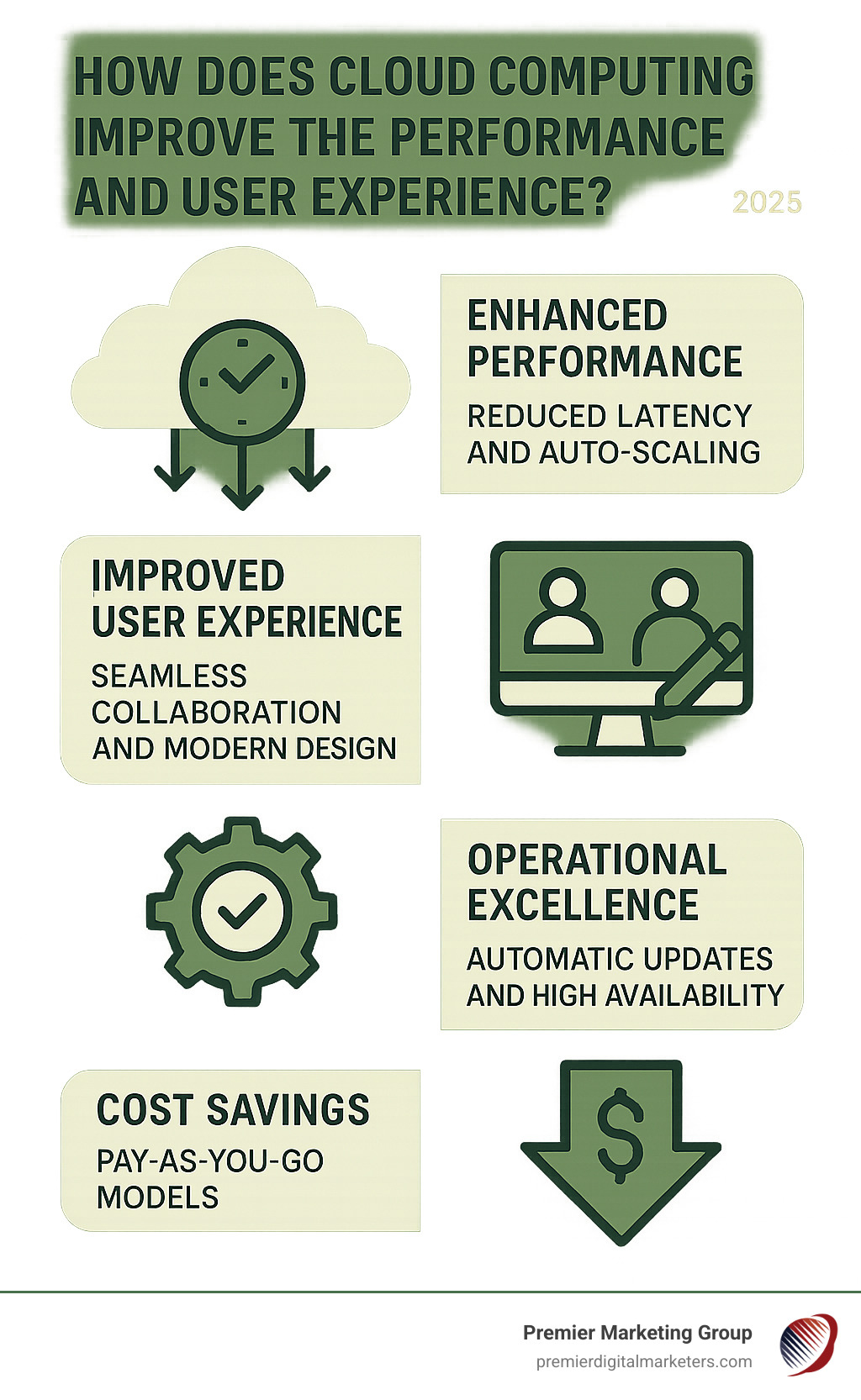
Cloud computing fundamentally reshapes the way companies design, build, and deliver digital services by providing on-demand access to a global pool of resources. According to Wikipedia, it is "the on-demand availability of computer system resources, especially data storage and computing power, without direct active management by the user." Instead of owning and maintaining physical servers, businesses can rent access to everything from applications to storage from a cloud provider. In practical terms, this translates directly into faster applications, significantly lower operational costs, and a demonstrably smoother user journey.
Performance at a Glance
User Experience Highlights
The data supports this shift: studies show 42 % of professionals cite better network performance as a primary reason for moving to the cloud, while a staggering 92 % of cloud-powered firms report higher user satisfaction. This isn't just a trend for large corporations. For small and medium-sized businesses, the cloud provides access to enterprise-grade muscle—powerful infrastructure, advanced security, and global scale—without the prohibitive enterprise price tag, leveling the playing field for innovation.
Further reading:
Traditional servers act like a single busy cashier. Cloud infrastructure is the self-checkout line that opens ten registers the moment a crowd appears. The result is shorter wait times and happier customers.
Key mechanisms include CDNs that cache content near visitors, intelligent load balancers that split traffic, and elastic resources that grow or shrink automatically. After moving to cloud hosting, one Pennsylvania retailer cut page-load time from 8 s to under 2 s and saw engagement jump 40 %.
For step-by-step tactics, see our guide on techniques to boost website performance and user experience.
Elasticity, or the ability to rapidly scale resources up or down, is a core cloud advantage. It lets you pay for computing power only when you need it. During a marketing campaign or a flash sale, your application can automatically spin up dozens of extra servers in minutes to handle the surge. Later, on a quiet Tuesday afternoon, those same resources spin down, trimming your operational costs. This dynamic auto-scaling converts unpredictable traffic spikes from potential crises into profitable opportunities, all while preserving a consistently smooth and responsive user journey.
In the digital world, speed is currency. Every extra 100 ms of delay can measurably cut conversions and damage user perception. To combat this, cloud vendors strategically place data in regional clusters and at the 'network edge,' physically closer to end-users. This geographical distribution is paired with smart routing, which directs user requests to the nearest, fastest server. Furthermore, modern cloud architectures enable on-demand code delivery, ensuring the core, visible experience loads almost instantly, with secondary features and scripts loading asynchronously in the background. This creates a perception of immediate responsiveness that is critical for user retention. Learn more about keeping systems responsive in our article on general system stability improvements to improve the user's experience.

Remote work is now routine, and cloud apps make it painless. No more email chains of "filev3final_FINAL.docx"—teams co-edit one document in real time, from any location or device.
Clients regularly report 30–40 % faster project cycles after adopting cloud tools. Dive deeper in improve user experience design.
Cloud apps must compete on simplicity and ease of use, which directly benefits the end-user. Modern cloud software prioritizes responsive, decluttered interfaces that provide a consistent and intuitive experience across phones, tablets, and desktops. For design and development teams, cloud-based tools offer scalable online prototyping, secure and centralized asset libraries, and channels for instant stakeholder feedback. This collaborative ecosystem streamlines the entire creative process, shortening the path from initial idea to a polished, market-ready launch. See more tips in UX design to improve website conversions.
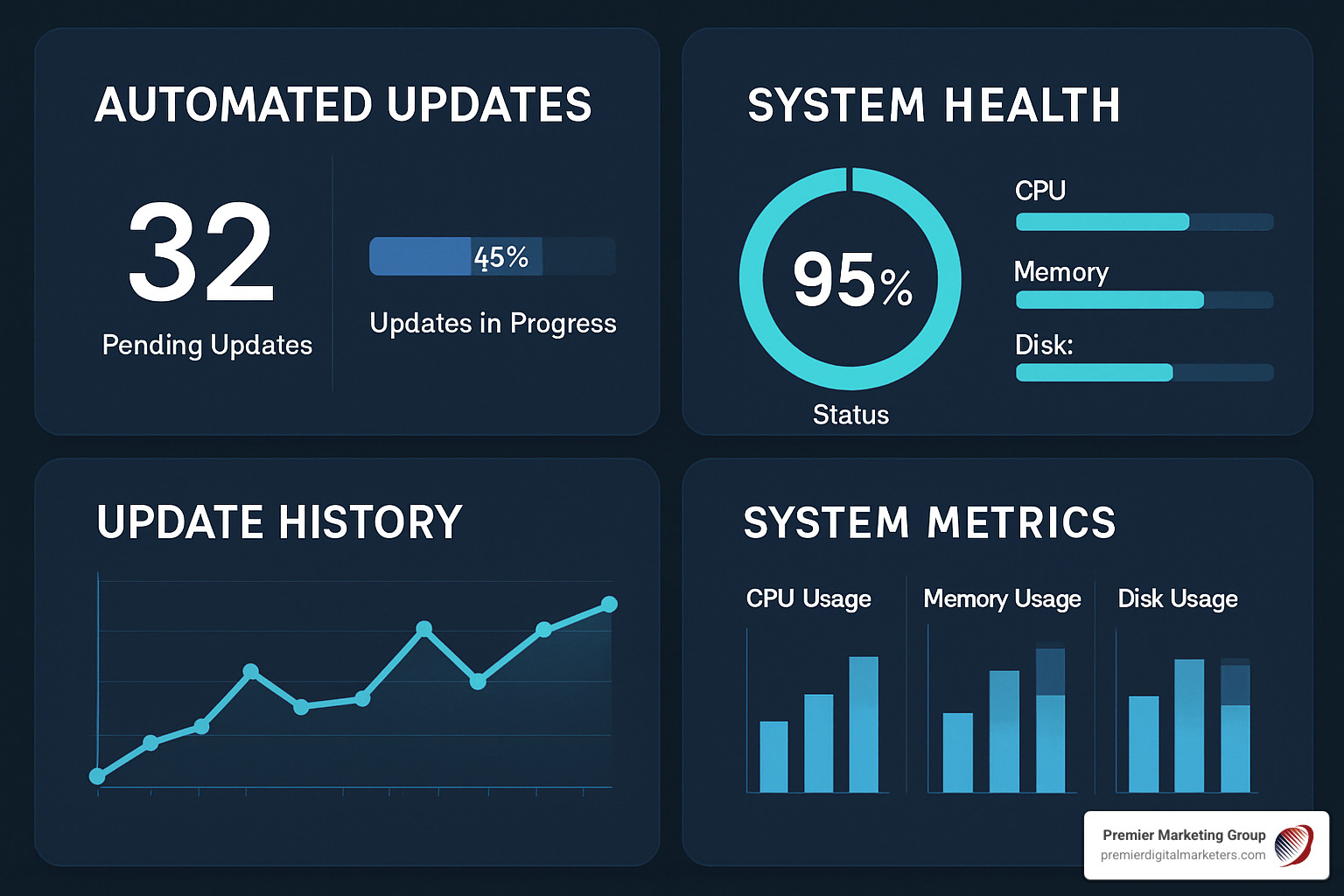
Cloud platforms deliver constant fine-tuning without the old "Please log off for maintenance" notices. Automated patching, continuous integration/continuous delivery (CI/CD), and predictive monitoring keep apps humming while users stay productive. This operational maturity means that improvements are delivered faster and more reliably than ever before.
With geographically distributed data centers, fault-tolerant architectural design, and 99.9 % (or better) Service-Level Agreements, cloud systems nearly eliminate single points of failure. If one component or even an entire data center fails, traffic is automatically rerouted to a healthy replica. Automatic backups and rapid disaster recovery protocols protect revenue streams and brand reputation, ensuring your services remain online even when the unexpected happens. Build a full plan with our user experience improvement plan.
Strong security and smart economics form the base of every cloud success story.
Dedicated expert teams, 24/7 monitoring, encryption by default, and multi-factor authentication give users confidence to engage fully. Enterprise-grade DDoS defenses keep sites responsive even during attacks.
Because hardware and maintenance disappear from your balance sheet, funds shift to features that delight customers—better design, faster support, richer content. Businesses typically cut IT costs by 20 % while boosting employee productivity 13 %. Learn more in our UI/UX improvement guide.
The shared-responsibility model gives you less to manage as you move from IaaS toward SaaS, freeing up your team to focus on core business goals.
Yes, for most businesses, the financial benefits are significant. You replace large, upfront capital expenses (CapEx) for hardware with predictable monthly operating costs (OpEx). More importantly, you pay only for the resources you actually consume, eliminating waste from over-provisioning.
| Factor | On-Premises | Cloud |
|---|---|---|
| Up-front spend | High (servers, networking, licenses) | Low to none |
| Maintenance | Ongoing (staff, power, cooling) | Included in service |
| Scaling | Slow, expensive, and manual | Instant and usage-based |
| Updates | Manual, often requires downtime | Automatic and seamless |
| Security | Full responsibility (DIY) | Shared, with enterprise-grade tools |
Most firms see around 20 % direct cost savings, but the indirect benefits, such as increased developer productivity and faster time-to-market, often deliver even greater financial returns.
Migration complexity varies depending on the age and architecture of your applications, but modern tools and proven strategies have made the process more accessible than ever. A common approach is to start small with a non-critical application to build experience. You can use a phased or hybrid approach, moving components over time rather than attempting a single, large-scale migration. Thorough testing and planning are key, and leaning on experienced partners for guidance can significantly de-risk the project and accelerate your timeline.
Cloud computing delivers the speed, reliability, and agility today’s users expect—without the infrastructure headaches of the past. Faster load times, seamless collaboration, automatic updates, ironclad security, and real cost savings put businesses that adopt the cloud ahead of slower-moving competitors.
Premier Digital Marketers can guide you through each step, from planning to launch and beyond. Ready to lift your digital presence? Transform your online presence with our expert design services.