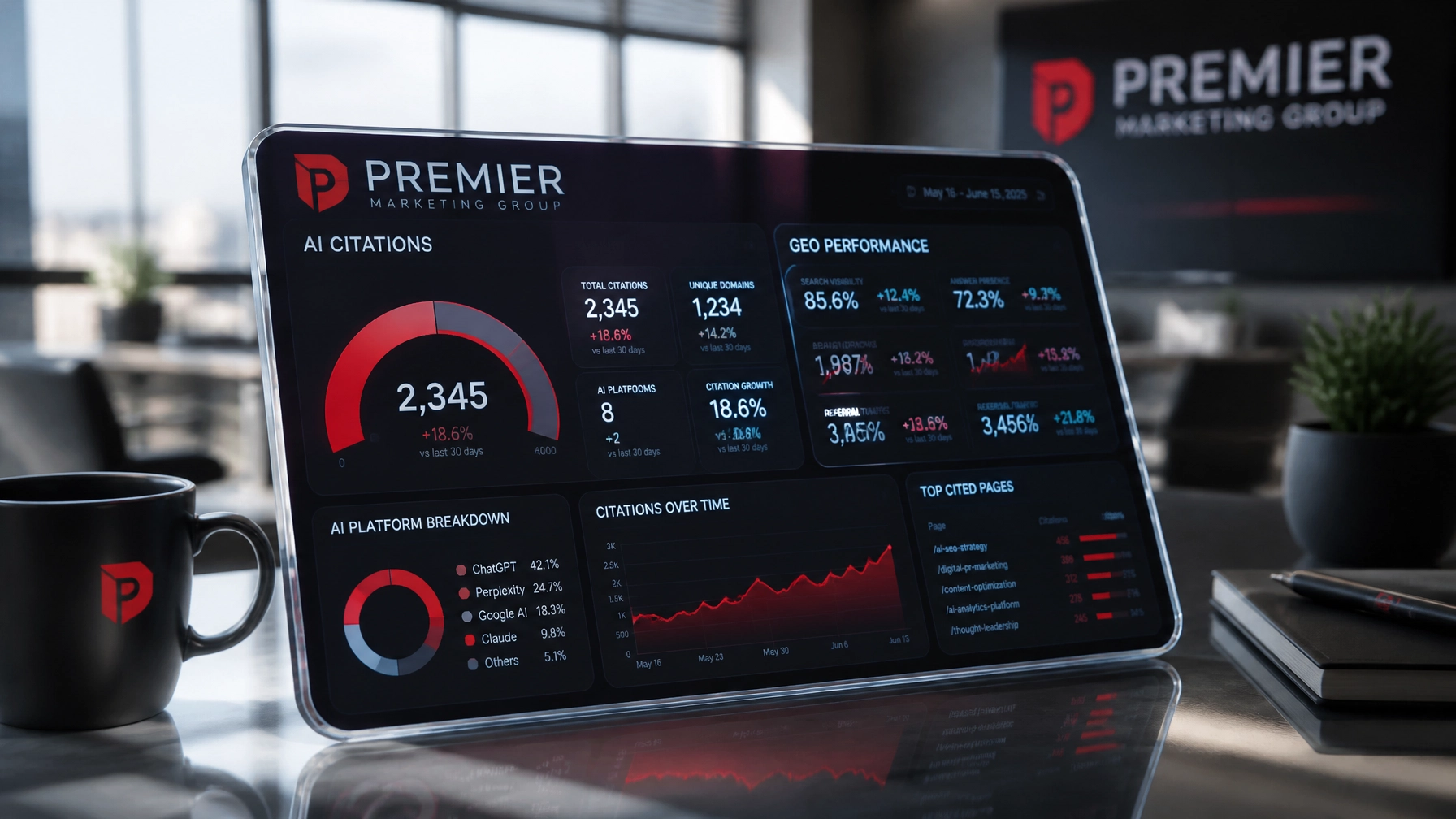
If a customer asks ChatGPT, Google AI, or Perplexity to recommend a plumber, dentist, roofer, accountant, or online store, will your business be part of the answer?
That question is becoming just as important as, “Where do I rank on Google?”
Generative Engine Optimization, or GEO, is the process of making your business easier for AI search engines to understand, verify, and cite. For local businesses, that means building a reliable network of website content, reviews, directory listings, expert information, and local references.
At Premier Marketing Group, we have spent more than 15 years helping small businesses improve visibility, generate leads, and build lasting digital authority. Our mission is simple: help you turn search visibility into measurable business growth before competitors capture the opportunity.
The bottom line: Traditional SEO helps you rank. GEO helps AI systems understand why your business deserves to be recommended.
An AI citation is a mention or link to a business, website, directory, article, or source used in an AI-generated answer.
For example, a homeowner might ask:
“Who are the most reliable roofing contractors near Harrisburg, PA?”
An AI platform may review business websites, Google Business Profiles, directories, customer reviews, and third-party articles before recommending several companies. If your business information is clear and consistent, your website may be cited as a source.
Think of an AI citation as a digital handshake. The AI system is telling the user, “This business appears to be supported by information I can verify.”
Local visibility is moving quickly in this direction. A Whitespark study reported that Google AI Overviews appeared for approximately 68% of local search queries, while traditional local packs appeared for about 39% of the queries studied. The exact numbers vary by query type and research method, but the trend is clear: AI-generated answers are becoming a major part of local discovery.
Read more about GEO and AI citations.

AI systems need to understand what your business does, where you operate, and who you serve. If your website uses vague language, outdated information, or inconsistent service descriptions, the system has to guess.
Guessing creates missed opportunities.
Review these details across your website and online profiles:
A plumber should clearly explain whether it offers drain cleaning, water heater repair, sewer services, or emergency response. A dentist should identify accepted insurance, treatment types, and new-patient procedures. An e-commerce brand should provide accurate product descriptions, shipping policies, inventory information, and return terms.
Google says local rankings are primarily influenced by relevance, distance, and prominence. Complete, accurate information supports relevance and helps search engines connect your business with the right local intent.
This is where local SEO services and professional web design services create a strong foundation.
AI search is designed to answer questions. Your content should do the same.
Instead of writing a service page that only says, “We provide quality HVAC services,” answer the questions a real customer would ask:
Lead each section with a concise answer of roughly 40 to 60 words. Then add supporting detail, examples, qualifications, and next steps.
This answer-first structure gives users what they need quickly while creating clear content blocks that AI systems can interpret. It also improves the experience for visitors who are scanning your page on a phone.
Do not hide your best information behind clever wording. State the answer plainly, then explain it.
For more foundational guidance, review our resource on search engine optimization services.
Your website matters, but it is only one piece of the GEO puzzle.
Recent local AI visibility research suggests that approximately 85% of brand mentions in AI search results may come from third-party sources, while only a smaller share comes directly from a company’s own website. That means AI systems are looking for outside confirmation.
Build your citation network by:
A roofing company may benefit from relevant construction directories and local community organizations. A dentist may need accurate profiles on healthcare platforms. An online retailer should prioritize product review platforms, shopping feeds, and trusted industry publications.
Quality beats quantity. Ten complete, credible profiles are more valuable than hundreds of thin listings that no customer uses.
Our guide to directory listings for SEO explains how to prioritize and maintain these digital references.
Reviews are not just social proof for human customers. They also help search engines understand your prominence and reputation.
Google specifically states that review count and score are factors within local prominence. Meanwhile, review research consistently shows that consumers rely heavily on reviews before contacting a local business.
Your review strategy should include:
A review saying, “The electrician replaced our outdated panel and explained every step,” provides more useful context than a generic five-star rating.
This is why reputation management for businesses should be part of your broader SEO strategy. Your online reputation is not a separate department. It supports visibility, trust, and conversion.
Structured data is code that helps search engines interpret the meaning of a page. It can identify your business name, address, phone number, services, hours, products, reviews, and frequently asked questions.
For a local business, your website may benefit from:
LocalBusinessDentist or ElectricianOrganizationServiceProductReviewFAQPageArticleStructured data is not a magic ranking button. Google does not describe LocalBusiness schema as a direct local-pack ranking factor. However, it helps search engines understand your entity and may support enhanced search appearances.
Think of structured data as labels on organized filing cabinets. The information was already there, but now search engines can locate the right detail faster and with less confusion.
Make sure visible page content matches the information in your schema. Never use markup to claim reviews, prices, or services that users cannot see on the page.
AI systems are more likely to trust content that demonstrates firsthand experience, clear attribution, and useful facts.
One academic GEO study found that named expert quotes increased citation probability by approximately 40.9%, while adding statistics increased citation probability by about 30.6%. These figures should not be treated as guaranteed results, but they show why original expertise matters.
Add details such as:
For example, an HVAC company could explain how older homes in south-central PA may present different heating challenges than newer construction. An accountant could publish a plain-English guide for small businesses preparing for tax season. An e-commerce brand could compare materials, care instructions, and delivery expectations.
Specific information makes your business more citable than generic claims such as “best service” or “quality products.”
GEO requires new measurements alongside traditional SEO reporting.
Track:
Run a monthly test using realistic prompts, such as:
Record the answer, the businesses mentioned, the cited sources, and the sentiment. Then improve the pages and profiles that are missing information.
GEO is not a replacement for traditional marketing. It works alongside SEO, paid advertising, branding, web design, and customer follow-up.
A complete strategy may include:
As a small business marketing agency, Premier Marketing Group uses a three-step transformation system to connect these activities to your actual goals. Whether you operate a landscaping company, law practice, dental office, or online store, the objective is the same: create a digital presence that customers and AI systems can understand and trust.
No. GEO builds on local SEO. You still need an accurate Google Business Profile, relevant website content, consistent directory listings, quality reviews, and a technically sound website.
No ethical consultant can guarantee a specific AI citation or recommendation. AI platforms change frequently and use multiple data sources. You can improve your chances by building accurate, authoritative, and consistent information across the web.
Not always. Many businesses can improve visibility by restructuring existing pages, correcting business information, adding FAQs, improving reviews, and implementing structured data. However, outdated or confusing small business web design can limit every other marketing investment.
Yes. E-commerce GEO includes accurate product descriptions, specifications, comparison content, review information, shipping policies, product schema, and third-party mentions. It helps AI systems understand which products fit a customer’s needs.
There is no universal timeline. Profile corrections may appear relatively quickly, while content authority, reviews, and third-party citations can take several months to develop. The most successful businesses treat GEO as continuous improvement rather than a one-time project.
The tipping point is here. Customers are already using AI to compare services, find professionals, and discover products. Businesses that provide clear answers, consistent information, and trustworthy proof will be easier to recommend.
Businesses that delay may continue bleeding visitors and missing high-intent opportunities to competitors who are easier for AI to verify.
Whether you need local SEO services, a digital marketing agency, reputation support, PPC management, or a marketing consultant to connect the pieces, Premier Marketing Group can help you build the next stage of your growth plan.
Start improving your GEO foundation now, measure what changes, and keep moving your business to the next level.
Schedule a marketing consultation with Premier Marketing Group.
Meta description: Learn how GEO and local SEO services help Harrisburg and Lebanon County businesses earn AI citations, improve trust, and win more local customers.