
If you own an HVAC company, dental practice, law firm, landscaping business, or ecommerce store, your 2026 marketing budget has to do two jobs: generate leads now and build visibility that keeps producing later.
For more than 10 years, Premier Marketing Group has helped small businesses turn search visibility into calls, appointments, and sales. As a trusted small business marketing agency, we have seen the same mistake repeatedly: businesses choose SEO or PPC as if they are competing investments. In reality, they work best as two parts of one growth system.
Think of SEO services as building an orchard. You prepare the soil, plant strategically, and maintain it consistently. The harvest takes time, but the asset can produce repeatedly.
PPC management is more like buying produce at the market. You can get results immediately, but you continue paying whenever you want more traffic.
Industry benchmarks show why both matter. Local SEO has been reported to produce a cost per lead 61% lower than traditional outbound marketing, while PPC often produces stronger short-term returns. One comparison found PPC delivered higher six-month ROI in 92% of cases, while SEO produced higher 24-month cumulative ROI in 78% of cases.
The bottom line: PPC buys speed. SEO builds equity.
For a deeper look at the fundamentals, review Premier’s guide to SEO vs. PPC for small business growth.
SEO becomes more valuable when you can commit to a 12- to 24-month growth horizon.
A local SEO strategy can include Google Business Profile optimization, technical improvements, service pages, reviews, local citations, internal links, and helpful content.
For example, a landscaping company serving the Lancaster area may create dedicated pages for hardscaping, lawn maintenance, drainage solutions, and seasonal cleanups. Each useful page creates another opportunity to match a customer’s specific need.
That is why SEO resembles a family under one roof: your website, reviews, business listings, and content should all communicate the same identity. When one part is inconsistent, the entire household feels less trustworthy.

PPC management is the right lever when you need qualified traffic quickly.
A well-structured campaign can place your business in front of searchers looking for:
PPC is especially useful when you are:
However, paid traffic exposes weak systems quickly. If your landing page is slow, your phone is unanswered, or your offer is unclear, you may be bleeding visitors and paying for missed opportunities.
Mobile devices account for approximately 57% of local searches, and consumers often act quickly after finding a nearby provider. Your PPC landing pages must therefore load quickly, show the phone number clearly, and make the next step obvious.
Explore Premier’s pay-per-click advertising services for help connecting campaign settings to measurable outcomes.
The right split depends on your current visibility, sales cycle, competition, and available budget. The following percentages apply to your search-growth budget, excluding branding, direct mail, and other campaigns.
Use this mix during the first six months if you need calls quickly.
After six months, review lead quality and gradually move toward a 50/50 SEO-PPC split.
Established service companies usually have enough history to benefit from compounding organic work.
Dentists, lawyers, and accountants often have higher customer value and longer decision cycles.
Professional practices should focus on qualified consultations rather than cheap leads.
An ecommerce development company or ecommerce brand may need paid campaigns to generate product demand immediately.
As organic product traffic grows, you can shift toward 45% PPC and 45% SEO.
SEO and PPC should share information instead of operating in separate rooms.
Paid campaigns can reveal:
Those insights can guide your SEO content and service-page priorities.
Organic data can show:
Strong local SEO signals also improve the experience after someone clicks an ad. Accurate business details, recent reviews, relevant pages, and fast mobile performance can increase trust and conversion rates.
As Rob Gundermann, Marketing Consultant, puts it: “The goal is not simply to be seen. The goal is to make it easy for the right customer to trust you and take the next step.”
AI Overviews and conversational search are changing how customers discover businesses. Instead of browsing ten blue links, a prospect may ask an AI system to recommend three providers.
That does not eliminate SEO or PPC. It makes clear business evidence more important.
Google says there are no special technical requirements for appearing in AI features beyond being indexed and eligible for standard search. Your priorities should be to:
Websites currently lead many AI citation sources, which means your website remains the home base for both traditional SEO and generative search visibility. Read Google’s guidance on AI features in Search and Premier’s guide to GEO for local businesses.

Your budget may be underperforming if:
Fix these issues before increasing spend. More budget will not repair a broken conversion process.
Use this simple formula:
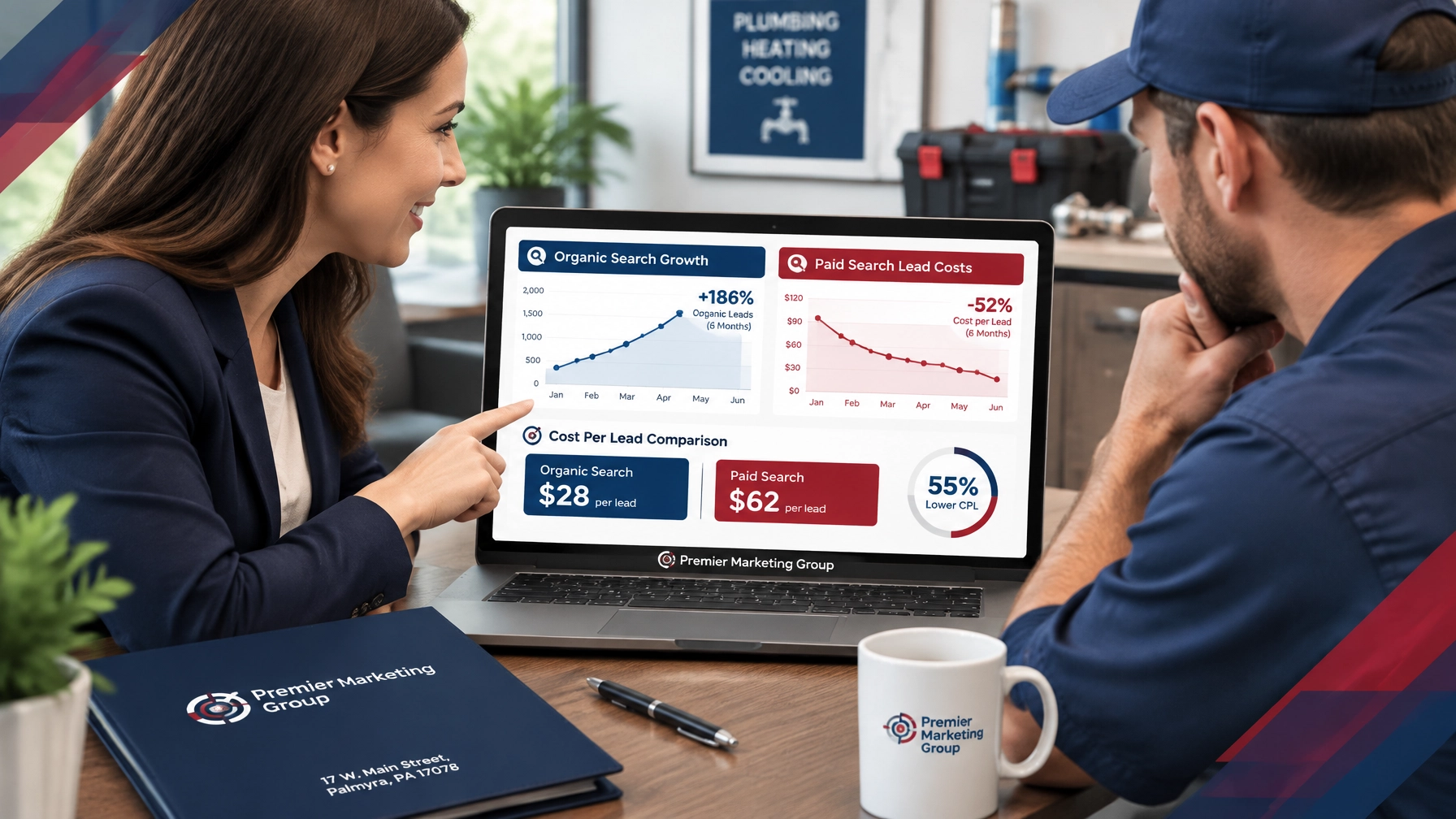
Cost per lead = Total channel cost ÷ qualified leads generated
For a more useful business metric, also calculate:
Cost per booked job = Total channel cost ÷ booked jobs
Suppose you spend $2,000 on PPC and receive 40 inquiries. Your initial cost per inquiry is $50. If only 10 are qualified and four become customers, your cost per qualified lead is $200 and your cost per customer is $500.
For SEO, calculate monthly investment against qualified organic leads. Then compare results over three, six, 12, and 24 months. SEO may look more expensive early because you are building the asset. Over time, the effective cost per lead can decline as visibility compounds.
Most businesses should use both. Start with more PPC if you need immediate leads, then increase SEO investment as rankings, reviews, and organic conversions improve.
A realistic starting point is often $2,000 to $5,000 per month for combined search marketing, depending on market competition and customer value. A marketing consultant can help prioritize the highest-return services.
Some technical and listing improvements can produce early gains, but meaningful organic growth commonly takes three to six months, with stronger compounding results developing over 12 months or more.
PPC usually creates a recurring cost for every click. SEO requires ongoing investment in content, technical work, and authority, but its effective cost per lead may decrease as visibility grows.
Choose a digital marketing agency that connects work to calls, appointments, qualified leads, and revenue. Avoid reports that only celebrate impressions and clicks.
SEO and PPC are not opposing choices. They are different tools for different stages of growth.
Use PPC to capture demand today. Use SEO to reduce acquisition costs tomorrow. Then connect both channels through accurate local information, strong web design, reputation management, and conversion tracking.
Premier Marketing Group has helped businesses build measurable marketing systems for more than a decade. Whether you need local SEO services, PPC management, ecommerce support, or a complete growth plan, we can help you identify the next highest-impact step.
Schedule a marketing consultation with Premier Marketing Group and build a budget designed to produce more qualified leads, booked work, and long-term growth.
Meta description: Compare SEO services and PPC management for local growth in 2026. Get practical budget splits, AI-search guidance, CPL benchmarks, and a measurable plan.
{"@graph":[{"@type":"Article","image":["https://cdn.marblism.com/qz2h79mX4Ap.webp","https://premierdigitalmarketers.com/wp-content/uploads/2026/10/T8A-wIohHK.webp","https://premierdigitalmarketers.com/wp-content/uploads/2026/10/81PxQyP4AXk.webp","https://premierdigitalmarketers.com/wp-content/uploads/2026/10/p7LmloNtMI0.webp"],"author":{"url":"https://premierdigitalmarketers.com/","name":"Premier Marketing Group","@type":"Organization"},"headline":"SEO Services vs. PPC Management: How Local Businesses Should Split Their 2026 Marketing Budget","publisher":{"url":"https://premierdigitalmarketers.com/","logo":{"url":"https://premierdigitalmarketers.com/wp-content/uploads/2020/11/Premier-Marketing-Group.svg","@type":"ImageObject"},"name":"Premier Marketing Group","@type":"Organization"},"description":"Compare SEO services and PPC management for local growth in 2026. Get practical budget splits, AI-search guidance, CPL benchmarks, and a measurable plan.","dateModified":"2026-10-01","datePublished":"2026-10-01","mainEntityOfPage":{"@id":"https://premierdigitalmarketers.com/","@type":"WebPage"}},{"@type":"FAQPage","mainEntity":[{"name":"Should a small business choose SEO services or PPC management?","@type":"Question","acceptedAnswer":{"text":"Most businesses should use both. Start with more PPC if you need immediate leads, then increase SEO investment as rankings, reviews, and organic conversions improve.","@type":"Answer"}},{"name":"How much should a local business spend each month?","@type":"Question","acceptedAnswer":{"text":"A realistic starting point is often $2,000 to $5,000 per month for combined search marketing, depending on market competition and customer value.","@type":"Answer"}},{"name":"How long does SEO take to work?","@type":"Question","acceptedAnswer":{"text":"Some technical and listing improvements can produce early gains, but meaningful organic growth commonly takes three to six months, with stronger compounding results developing over 12 months or more.","@type":"Answer"}},{"name":"Is PPC more expensive than SEO?","@type":"Question","acceptedAnswer":{"text":"PPC usually creates a recurring cost for every click. SEO requires ongoing investment in content, technical work, and authority, but its effective cost per lead may decrease as visibility grows.","@type":"Answer"}},{"name":"What should I look for in a digital marketing agency?","@type":"Question","acceptedAnswer":{"text":"Choose a digital marketing agency that connects work to calls, appointments, qualified leads, and revenue. Avoid reports that only celebrate impressions and clicks.","@type":"Answer"}}]}],"@context":"https://schema.org"}