If you own a local business, being visible in search now means more than appearing in a traditional Google result. Customers increasingly ask AI tools questions such as, “Who is the best HVAC company near Harrisburg?” or “Which family dentist should I call?”
The answer may name only one or two businesses instead of showing the familiar three-pack. That creates a new tipping point: your business must be easy for AI systems to understand, verify, and recommend.
Premier Marketing Group has helped small businesses improve their marketing for more than 10 years. Our mission is to help home-service companies, professionals, and ecommerce brands turn search visibility into measurable calls, appointments, leads, and sales.
Traditional local search commonly presents a map pack or a list of several organic results. AI answers work differently. They summarize information into a conversational response and may select only one or two businesses as examples or recommendations.
That does not mean AI systems use a single “GEO ranking formula.” ChatGPT, Google AI Overviews, Gemini, Perplexity, and other tools use different systems, data sources, retrieval methods, and response formats. Results can also change based on the wording of the question, the searcher’s location, and the time of day.
However, the pattern is clear: AI needs strong evidence before it confidently names a local business.
Google explains that AI Overviews and AI Mode may use a “query fan-out” process, running several related searches across different sources before generating an answer. Google also says there are no special technical requirements for appearing in AI features beyond being indexed and eligible for regular search.
That means GEO is not an AI ranking hack. It is the process of making your business information clearer and more trustworthy across the web.
Start with the basics. Your business name, address, phone number, website, hours, service area, and primary category should be accurate everywhere.
Check:
Even small inconsistencies can create uncertainty. For example, if one directory lists an old phone number and another uses a different business name, an AI system may have a harder time determining which information is reliable.
Think of your business data as a digital handshake. Every platform should communicate the same identity.
AI tools need clear answers they can understand and summarize. A vague page titled “Our Services” is less helpful than a dedicated page that explains one service in plain English.
For each important service page, answer these questions near the beginning:
An HVAC company should explain furnace repair, maintenance, emergency service, and replacement separately. A law firm should distinguish practice areas instead of placing every service on one page. A dental practice should clearly explain new-patient appointments, emergency visits, insurance, and procedures.
Put the answer before the sales pitch. Customers and AI systems should not have to dig through five paragraphs to find out whether you serve their area.
For help improving your website structure, explore Premier Marketing Group’s custom website design services.
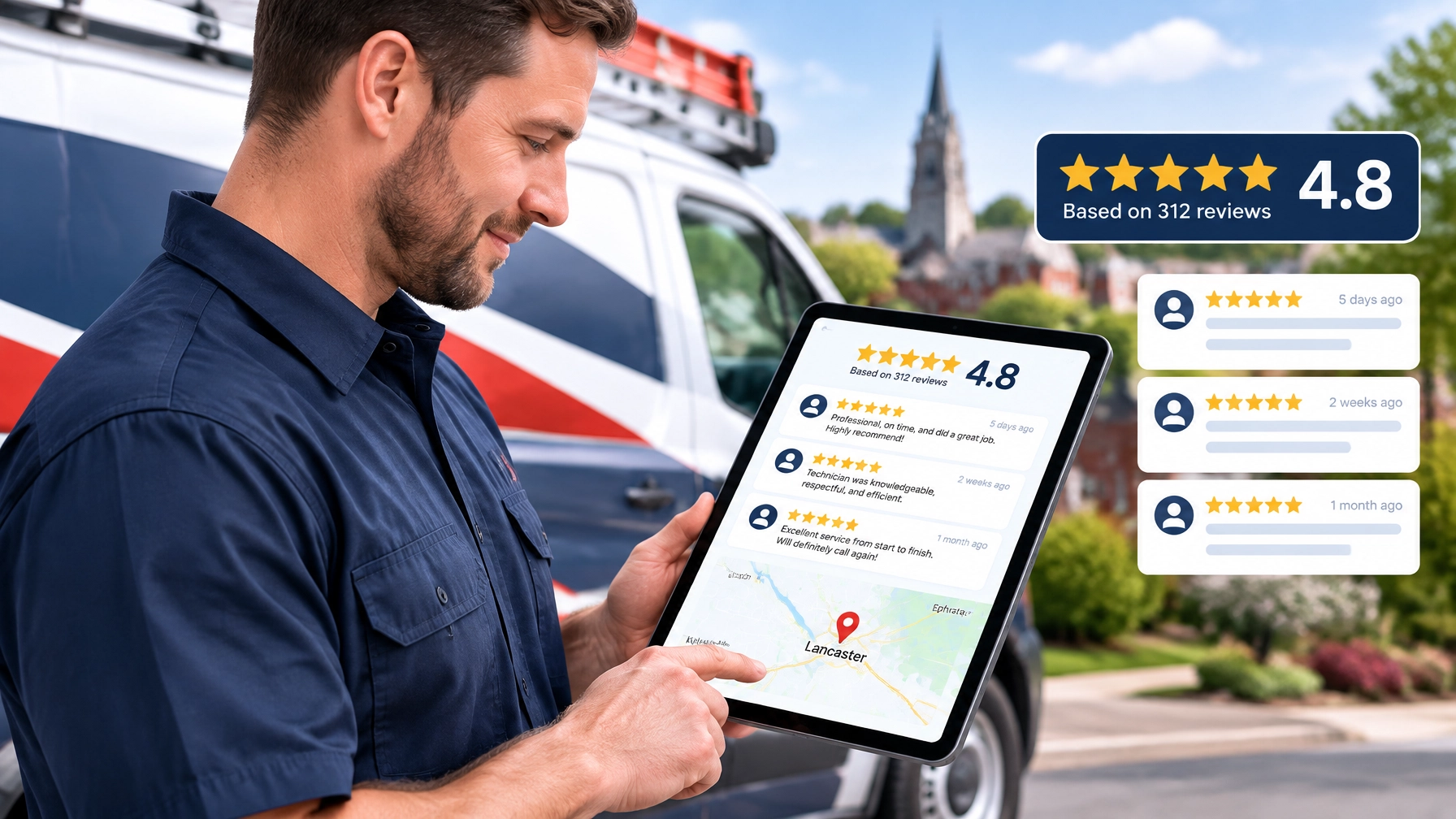
Reviews are not only about star ratings. The words customers use can help reinforce your services, location, and strengths.
BrightLocal’s 2025 research found that 71% of consumers read online reviews regularly, while 83% use Google to find local business reviews. The research also shows that many consumers check more than one review source before making a decision.
A review that says, “The electrician arrived on time, explained our panel upgrade, and completed the work at our Harrisburg home,” provides much more context than “Great company.”
Build a review process that helps customers describe:
Never write fake reviews or pressure customers to use specific language. Instead, ask for honest feedback shortly after a completed job or appointment. Then respond to every review. BrightLocal reports that 89% of consumers expect businesses to respond to both positive and negative reviews.
Our guide to reputation management for businesses explains how to make this process consistent.

A citation is a public mention of your business information. It may appear in a directory, local publication, professional association profile, community organization page, or industry website.
The goal is not to place your business in every directory available. The goal is to appear accurately in sources that make sense for your market.
Prioritize:
Quality and consistency matter more than directory volume. A clean profile on 10 credible platforms is more useful than hundreds of low-quality listings with outdated information.
If your citation information needs work, review Premier’s resource on directory listings for SEO.
AI systems cannot reliably understand information they cannot access. Important business facts should appear as visible, crawlable text on your website.
Check whether your key information is:
Google specifically recommends allowing crawling, using internal links, making important content available in text, and ensuring structured data matches visible content.
You do not need to create a special “AI page.” You need a website that works for people and search systems. Google’s guidance on AI features in Search confirms that strong SEO fundamentals remain the foundation.
Ask each platform five to 10 questions your customers might ask. Use natural wording, such as:
Record:
Do not test only “best business in town.” Include service-specific, problem-specific, and location-specific questions.
Create a spreadsheet with your official business name, address, phone number, hours, website, categories, and service areas. Compare that information across your website and priority listings.
Mark each item as:
Fix the most important discrepancies first.
Choose the two or three services that produce the most revenue. Make the opening section answer what you do, where you work, and how customers can get started.
Add helpful FAQs, real photos, customer outcomes, service-area details, and clear calls to action. Link these pages from your main navigation and related blog posts.
Ask recent customers for honest feedback. Identify the five most important directories or industry profiles that need updates. Schedule a recurring monthly review of new mentions, reviews, and business information.
This process is not complicated. The missed opportunity is waiting another six months while inaccurate information continues circulating.
AI visibility is difficult to measure with a single ranking report. Instead, build a repeatable testing process.
Once a month, record:
Track trends rather than one-off wins. A single ChatGPT answer does not prove a strategy worked, and one missing citation does not mean your marketing failed.
Google also reports traffic from AI features through the overall “Web” search type in Search Console. Combine that data with analytics, call tracking, form submissions, and booked jobs.

There is no legitimate shortcut that guarantees ChatGPT placement or a permanent Google AI citation. Be cautious of anyone promising a secret prompt, special schema, or fixed number-one position.
Repeating “best electrician Harrisburg” dozens of times makes content harder to read and may look manipulative. Write naturally and explain your actual service area.
AI can assist with research and organization, but your content should include real expertise, original examples, customer questions, and accurate business details. Google emphasizes helpful, reliable, people-first content.
Artificial reputation signals can damage customer trust and create compliance problems. Build authority through real work, honest feedback, and legitimate community or industry relationships.
For ecommerce brands, GEO also depends on accurate product information, availability, shipping details, return policies, product reviews, and a crawlable catalog. AI visibility cannot compensate for confusing product pages or broken checkout experiences.
No. GEO builds on local SEO. Accurate listings, helpful content, strong reviews, internal links, technical accessibility, and a good user experience support both traditional and AI search.
No. ChatGPT responses can vary, and there is no ethical way to guarantee placement. You can improve the clarity and credibility of your public information, but the final response is controlled by the platform.
There is no universal number. Focus on a steady flow of authentic, recent, detailed reviews and respond to them consistently. Review quality, relevance, and customer trust all matter.
Usually, no. Create useful service pages, location information, FAQs, and company details for your customers. A clear website is more valuable than a page written only for an AI system.
Basic corrections may be reflected after platforms recrawl or update their data. Broader improvements in content, reviews, citations, and authority can take weeks or months. Track progress monthly rather than expecting an overnight change.
The move from traditional search results to AI-generated answers is not a reason to panic. It is a reason to make your business easier to understand.
Start with accurate information. Add direct answers to your service pages. Build specific, recent reviews. Strengthen credible citations. Make your content crawlable. Then measure what changes.
Premier Marketing Group has helped businesses improve their marketing systems for more than a decade. If you need support with SEO services, web design, reputation management, or a broader local SEO strategy, we can help you identify the highest-impact next step.
Do not chase guaranteed AI placement. Build a business that AI systems can confidently understand, and customers can confidently choose.
Schedule a consultation with Premier Marketing Group and take your marketing to the next level.
Meta description: Learn how GEO helps local businesses earn citations in ChatGPT and Google AI with an actionable audit for business data, reviews, content, and crawlability.